In a fast-paced world filled with information and distractions, nurturing a child’s ability to think clearly and independently is more important than ever. This is where critical thinking skills come in. Play isn’t just fun – it’s a powerful tool for developing essential life skills. Through the right kind of play, children can learn to question, reason, solve problems, and make thoughtful decisions.
Let’s explore what critical thinking skills are, why they matter, and how to foster them in children through simple yet effective play-based activities.
What are Critical Thinking Skills?
Critical thinking skills are the ability to analyze information, make logical connections, evaluate different possibilities, and solve problems effectively. For kids, this means asking “why” and “how,” observing carefully, experimenting with ideas, and learning to approach challenges with curiosity and reasoning.
These skills form the foundation for smarter decision-making and academic performance later in life.
What is critical thinking in kids?
Critical thinking in kids refers to their ability to think independently, evaluate options, ask relevant questions and solve problems creatively. It helps them understand the world, make good decisions, and become active learners. These skills can be introduced as early as preschool through guided play and open-ended questions that encourage reasoning and exploration.
Why Is Critical Thinking Important in Early Childhood?
Developing critical thinking skills in students from a young age boosts their emotional intelligence, independence, and academic abilities. It’s not about memorizing facts – it’s about understanding concepts and using logic.
Children who learn to think critically:
- Become confident decision-makers
- Are better problem solvers
- Handle peer pressure wisely
- Communicate more effectively
- Are less likely to follow misinformation
That’s why, at Satyameva Jayate International School, we focus on games, challenges, and group activities that trigger curiosity and logical reasoning.
Critical Thinking Skills Examples in Children
Here are a few simple critical thinking skills examples observed in preschoolers:
- A child solving a puzzle by figuring out which shape fits where
- Asking, “Why do plants need water?” after watering a classroom plant
- Choosing between two toys based on how they function or feel
- Building a taller block tower after a shorter one collapses
These moments may seem small, but they reflect deep cognitive engagement.
How to Develop Critical Thinking Skills in Kids through Play
1. Open-Ended Play
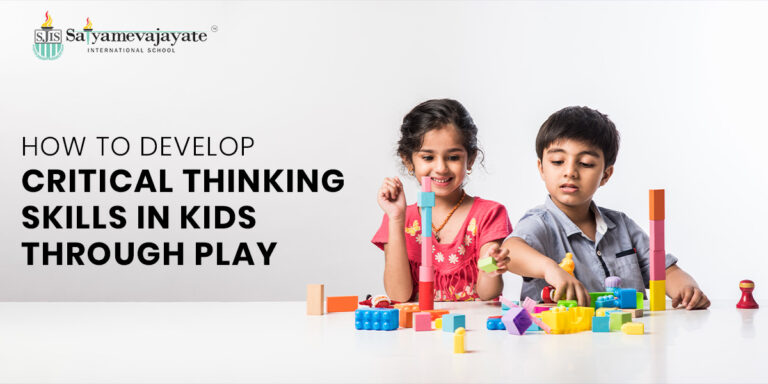
Toys that don’t have a single “correct” use – like building blocks, clay, or dress-up kits – encourage experimentation. Children try new ideas, face failures, and learn to adjust.
Example: Let your child build a house with blocks. If it falls, ask, “What could make it stronger?” Let them come up with solutions.
2. Ask Thought-Provoking Questions
Encourage children to explain their thinking. Questions like:
- “Why do you think that happened?”
- “What would happen if we changed this?”
- “What else can we try?”
These spark curiosity and teach children to think through outcomes rather than jump to conclusions.
3. Puzzle Play and Brain Teasers
Jigsaw puzzles, memory games, mazes, and riddles stimulate logical thinking.
Tip: Gradually increase the difficulty to match the child’s development.
4. Role-Playing and Pretend Games
Dramatic play promotes empathy, problem-solving, and perspective-taking. When children act out real-world scenarios-like being a doctor, chef, or shopkeeper-they explore decisions and consequences.
Example: In a pretend grocery store setup, children learn to count, compare, and decide what to “buy” and “sell,” enhancing both math and thinking skills.
5. Outdoor Challenges and STEM-Based Play
Games like scavenger hunts, building ramps, or creating simple machines with recycled materials offer fantastic opportunities to combine play with problem-solving.
Reference Insight: As highlighted by Engineering for Kids, science-related play fuels critical thinking by encouraging children to hypothesize, test, and revise outcomes.
How to teach children critical thinking skills?
You can teach kids critical thinking skills by engaging them in open-ended play, asking “why” and “what if” questions, and encouraging problem-solving through games and storytelling. Activities like puzzles, dramatic role-play, and group challenges help children explore cause-and-effect relationships, build logical thinking, and learn through trial and error—all while having fun.
How Can Parents Encourage Critical Thinking at Home?
Parents play a key role in supporting critical thinking. Here’s how:
- Avoid giving quick answers: Instead, guide children to think through the problem.
- Praise efforts, not just results: This encourages perseverance.
- Model thinking out loud: Share how you make decisions or solve problems.
- Create a safe space to fail: Let kids make small mistakes and learn from them.
- Read books with questions: Ask your child, “What do you think will happen next?”
How to develop critical thinking skills in students at home?
To develop critical thinking skills in children at home, encourage open conversations, let them make small decisions, and involve them in everyday problem-solving. Use storytelling, logic-based games, and thought-provoking questions to guide their critical thinking and reasoning. Allowing space for mistakes and reflection teaches kids how to think, not just what to think.
Satyameva Jayate International School: Where Play Meets Purpose
As the Best CBSE School in Ahmedabad, Satyameva Jayate International School understands the power of play in shaping young minds. Our classrooms are not just places to learn the alphabet or count numbers – they’re environments where children question, experiment, and grow into thoughtful individuals.
With experienced educators, interactive spaces, and child-centric programs, we ensure that every child who walks through our doors is prepared not just for school, but for life.
Conclusion
Building critical thinking skills doesn’t require expensive materials or complex lessons. All it takes is thoughtful play, patient listening, and a nurturing environment – like the one we offer at Satyameva Jayate International School.
By allowing children to explore, question, and make sense of their world, we prepare them to become curious learners, creative thinkers, and confident individuals.

Recent news
- All Post
- Career Guidance
- CBSE School
- Holistic Education
- Science Quiz
- Student Tips